


Guests who have read our dahabiya or cruise ship comparison often ask the next question: what does a day actually feel like on each? I work on both boats, so here is one ordinary day on a cruise ship and one on a dahabiya, from the first call in the morning to the mooring at night.
- A cruise ship day is full and runs to a shared timetable: a temple at 6:30, sailing by 1 pm, lunch on board, the sun deck in the afternoon, dinner at a set hour.
- A dahabiya day is slow and runs to its own programme: hours under sail, small stops like El Kab and Gebel el Silsila, nights tied up at islands.
- The headline sites are the same on both, including the full Luxor day on both banks.
- Ships moor at the towns; dahabiyas moor at the quiet places in between.
- Neither day is better. They suit different travellers, and the price is on each boat’s page.
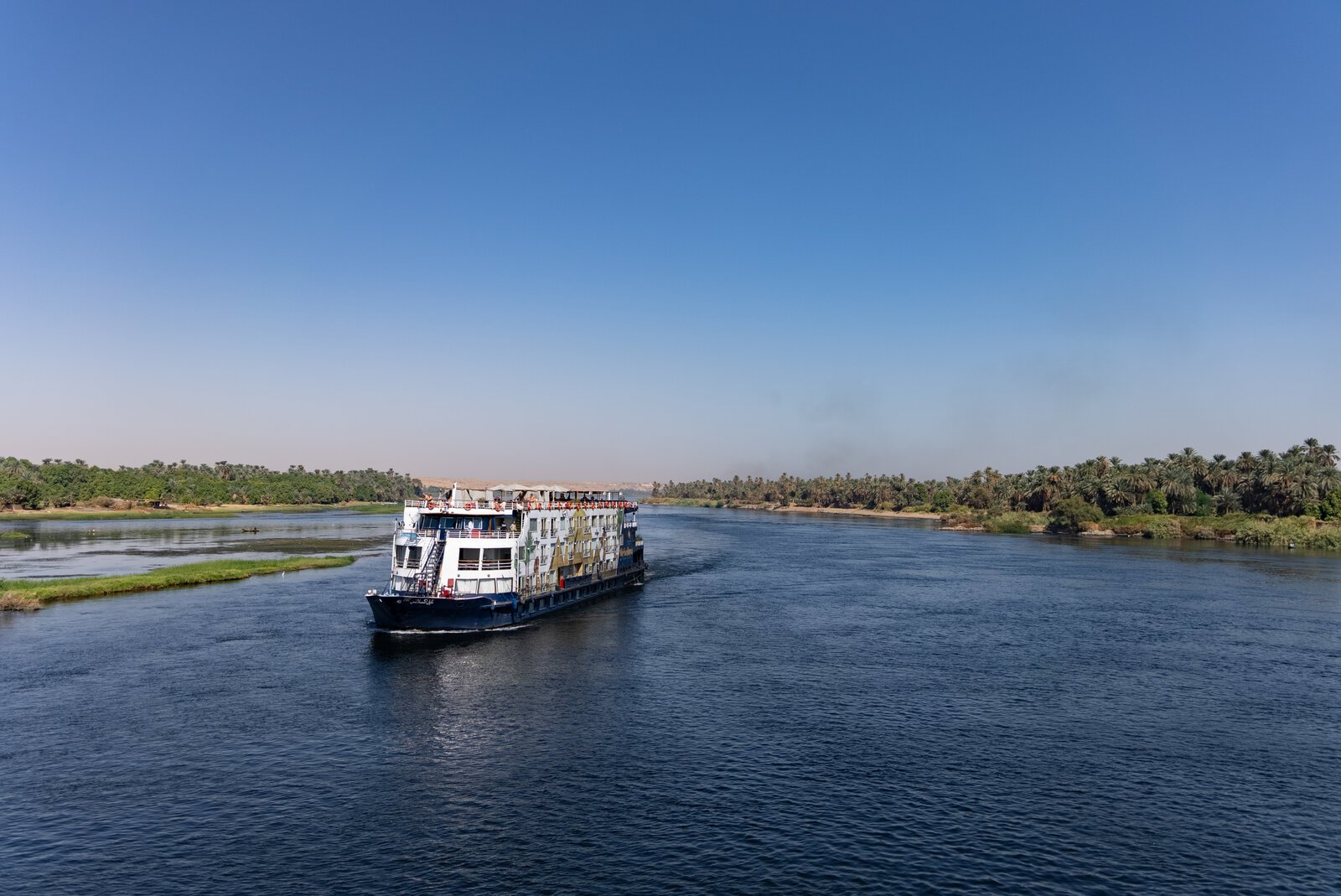
The cruise ship day, hour by hour
On most mornings you are off the ship by 6:30, sometimes 5:30 in summer, and standing in a temple before the heat and the coaches arrive. That early start is the best decision on the whole cruise: the big sites are cooler, quieter and better lit in the first hours. By 10 or 11 you are back on board.
The ship sails around 1 pm and lunch is served as it goes, a buffet cooked fresh on board. The afternoon belongs to the river: the sun deck, the pool, tea in the lounge, and on some days a second site, Kom Ombo in the late afternoon or Luxor Temple as the light goes. Dinner is at 7:30 in winter and 8 in summer, and many ships put on something in the evening, a galabeya party or a Nubian show. The ship spends the night moored at a town: Luxor, Esna or Edfu, Kom Ombo, Aswan.
The dahabiya day, hour by hour
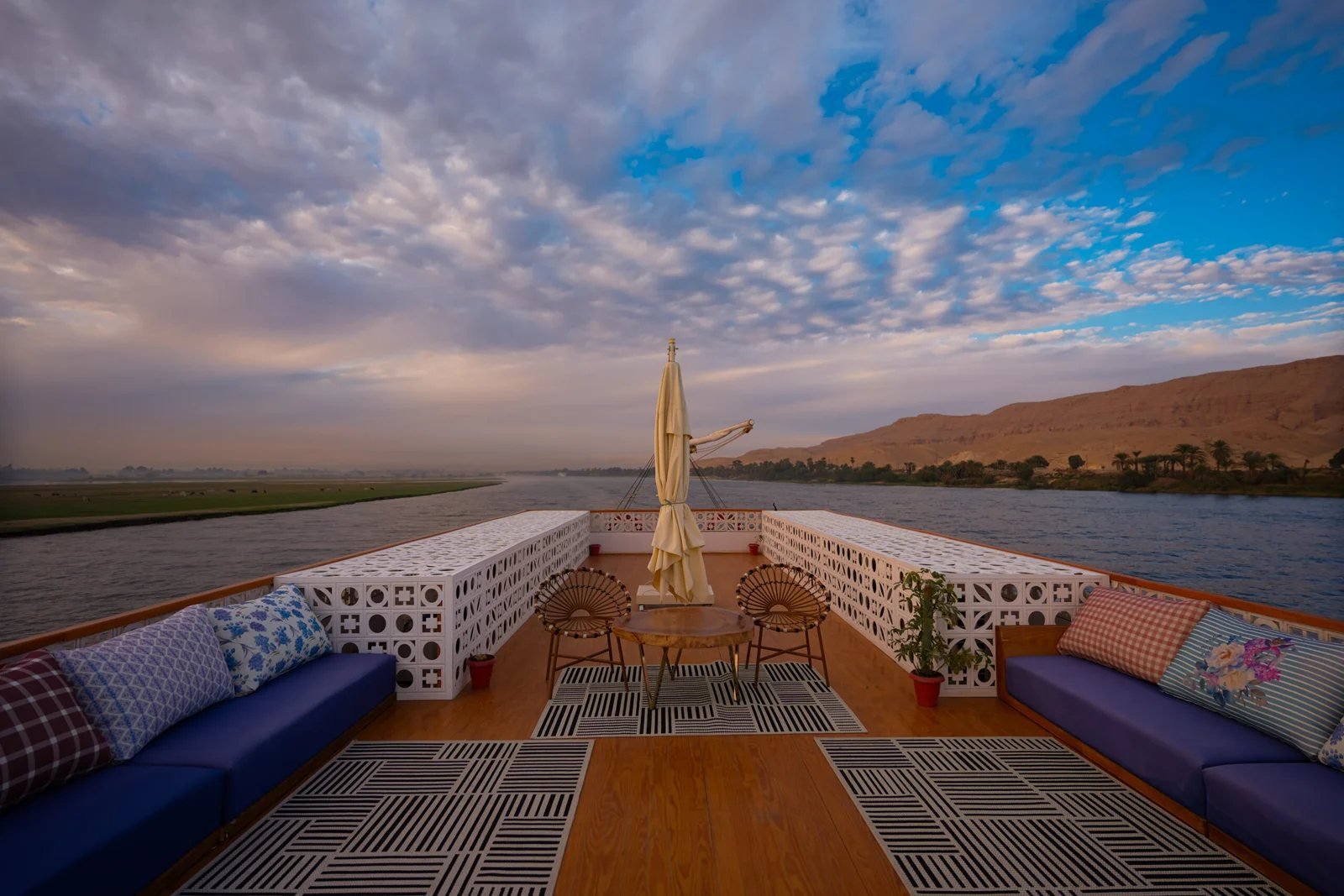
A dahabiya morning starts more gently. There are ten or so cabins and everyone eats together, so breakfast feels like a house party, not a hotel. Each dahabiya keeps its own sailing programme rather than the shared ship timetable, which is why no two dahabiya days are quite alike.
The middle of the day is the point of the whole boat: hours under sail, with the farmland passing at walking speed and no engine under your feet. When the wind drops, a tug boat takes over and the schedule holds. The stops are the small places a ship cannot reach: the rock tombs of El Kab, the sandstone quarries of Gebel el Silsila, villages and islands. In the evening the crew ties up at an island or a quiet bank, not a town quay, and the only sound at night is the river. Dinner is cooked on board and served at one table, often on deck when the evening is warm.
The sightseeing is the same where it counts
Whichever boat you choose with us, you see Philae and the felucca sail at Aswan, Kom Ombo, Edfu, and the full Luxor day on both banks: the Valley of the Kings, Hatshepsut, the Colossi of Memnon, Karnak and Luxor Temple. On every dahabiya programme the complete Luxor East and West Bank day is included. The guide is a licensed Egyptologist on both. What changes is everything between the temples: the pace, the company, and where you wake up.
Where each boat spends the night
This is the difference guests remember. A ship moors at a town, often alongside other ships, with the lights and sounds of a working quay. A dahabiya ties up where the crew likes the bank: an island, a palm grove, a stretch of river with nothing on it. Stepping off the boat onto a quiet island before dinner is the moment most dahabiya guests talk about for years.
Which rhythm suits you
If you want facilities, a pool, a livelier evening and the best price, the ship’s day will suit you. If you want quiet, sailing and the stops nobody else makes, the dahabiya’s day will. The full comparison, with prices and how to decide, is in dahabiya or cruise ship, and the boats themselves are compared in six Nile dahabiyas compared. Send us your dates on WhatsApp and we will tell you which boats sail that week.
Before you travel
- Dahabiya or cruise ship: the decision itself, with the price difference.
- The small sites only dahabiyas visit: El Kab, Gebel el Silsila and the islands.
- Food and drink on a Nile cruise: the buffets, the water and the bar bill.
- The heat on a Nile cruise: why every day starts at 6:30.
Questions
What time does the day start on a dahabiya?
Later than on a ship, usually. Each dahabiya keeps its own programme, and with a small group the guide can set the morning around the guests rather than a shared timetable.
Is a dahabiya too slow if I want to see everything?
No. The headline sites are all included, with the full Luxor day on both banks. What the dahabiya trades away is on-board facilities, not sightseeing.
Do dahabiyas have a pool?
Some do and some do not. The boats differ in their extras, a plunge pool, a gym or a sauna on some, and each boat’s page lists what it carries.
What are evenings like on each?
On a ship: dinner at a set hour, then a show, the bar or the deck. On a dahabiya: dinner at one table, then the deck and the stars. There is no entertainment programme on a dahabiya, and that is the point.
Can I visit the small sites from a cruise ship?
No. El Kab and Gebel el Silsila have no moorings for big ships. They are reached on dahabiya programmes, and most of our dahabiyas stop at Gebel el Silsila.
Is the guide the same on both?
Yes. Every cruise we sell, ship or dahabiya, includes sightseeing with a licensed Egyptologist guide.
