

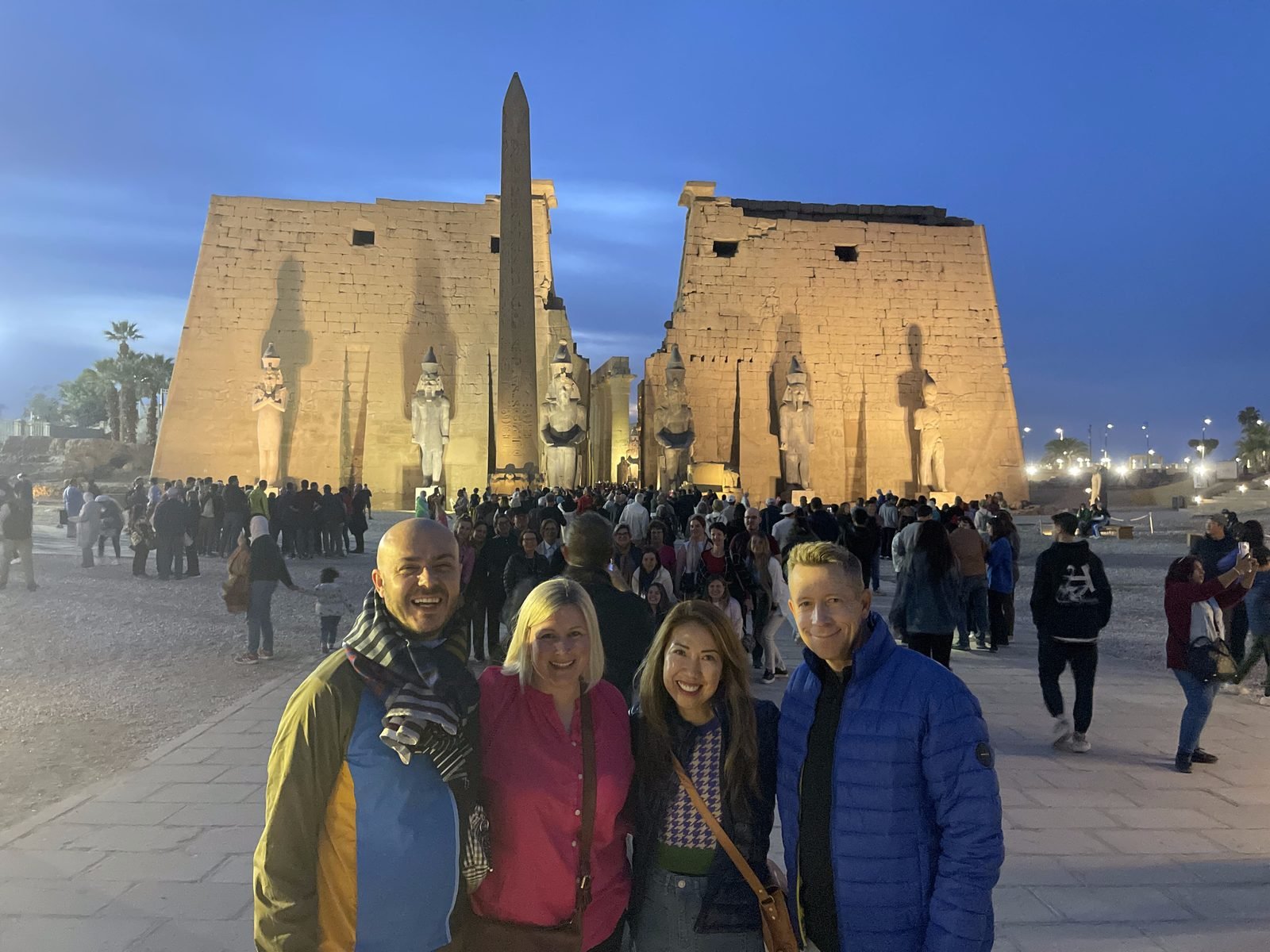
A Nile cruise itinerary between Luxor and Aswan covers the same sites whichever way you sail: Karnak and Luxor Temple on the East Bank at Luxor, the Valley of the Kings, Hatshepsut and the Colossi of Memnon on the West Bank, Edfu, Kom Ombo, and Philae with the Unfinished Obelisk at Aswan. Three nights sails north from Aswan, four nights sails south from Luxor, and the order of the days changes with the direction. Here is what you see on each day, what to look for at each site, and where the days are long.
- Three nights, Aswan to Luxor: Philae, the Unfinished Obelisk and a felucca on day one, Kom Ombo and Edfu on day two, both banks of Luxor on day three, off the ship on day four.
- Four nights, Luxor to Aswan: Karnak and Luxor Temple on day one, the West Bank on day two, Edfu and Kom Ombo on day three, Aswan on day four, off the ship on day five.
- The sites are the same on both. Four nights adds an evening on the water and spreads Luxor over two days.
- A typical day starts around 6:30 in the morning at a temple and has the ship sailing by 1 pm, with lunch on board.
- Abu Simbel and the balloon over Luxor are optional, and not part of the standard programme.
What a day on the ship looks like
Most days follow the same rhythm. You are out to the first temple at around 6:30 in the morning, before the heat and before the coaches. The ship is sailing by about 1 pm, and lunch is served on board as it goes. The afternoons are for the sundeck and the river, with a second site on some days. Dinner is at 7:30 in the evening in winter and 8 in summer.
The early starts matter more than people expect. The big sites are cooler, quieter and better lit in the first hours of the day, and a guide can talk you through a temple properly when you are not queuing at every doorway.
Three nights, Aswan to Luxor
Day 1: Aswan, Philae and a felucca
You board in Aswan and have lunch on the ship. In the afternoon a boat takes you across to Philae, the temple of Isis on its island. The Unfinished Obelisk follows, and the day ends with a felucca around Elephantine Island as the light goes. You sleep on the ship, moored at Aswan.
Day 2: Kom Ombo and Edfu
Breakfast while the ship sails north. Kom Ombo stands right on the bank, so you walk straight off the ship into it. Lunch on board as you sail on to Edfu, then a short ride up from the mooring to the temple of Horus. The night is spent at Edfu.
Day 3: Luxor, both banks
The ship reaches Luxor overnight. The West Bank comes first: the Valley of the Kings, Hatshepsut’s terraced temple and the Colossi of Memnon. Back on board for lunch, then the East Bank in the afternoon, Karnak first and Luxor Temple as the light goes. This is the longest day of the three.
Day 4: Luxor, departure
Breakfast on board, then off the ship and to Luxor airport or your hotel.
The full three night programme, with what is included each day, is on three nights, Aswan to Luxor.
Four nights, Luxor to Aswan
Day 1: Luxor, Karnak and Luxor Temple
You board in Luxor and have lunch on the ship. In the afternoon Karnak, then Luxor Temple as the light goes. The night is spent moored at Luxor.
Day 2: The West Bank, then sailing south
An early start if you want the balloon. After breakfast, the Valley of the Kings, Hatshepsut and the Colossi of Memnon. Lunch on board as the ship sails south through the lock at Esna, and the night is spent at Edfu.
Day 3: Edfu and Kom Ombo
Edfu in the morning, Kom Ombo in the afternoon after sailing on with lunch on board, then on to Aswan for the night.
Day 4: Aswan
Philae, the Unfinished Obelisk and a felucca around Elephantine Island. Dinner and the night on the ship at Aswan.
Day 5: Aswan, departure
Breakfast on board, then off the ship and to Aswan airport or your hotel.
The full four night programme is on four nights, Luxor to Aswan. Luxor is split over two days on this route, which makes it the easier of the two if you are travelling with children or anyone who tires in the heat.
The sites, and what to look for
Karnak
The largest temple complex in Egypt, built and rebuilt over some two thousand years. Most people remember the Great Hypostyle Hall, 134 columns so broad and tall that you lose the sky between them. Look up at the tops of the columns and you can still see the original paint.
Luxor Temple
Smaller than Karnak and linked to it by an avenue of sphinxes nearly three kilometres long. It is lit after dark, which is why we take you there at the end of the day. The single obelisk at the entrance once had a twin, which now stands in the Place de la Concorde in Paris.
The Valley of the Kings
The burial valley of the pharaohs of the New Kingdom, cut into the hills of the West Bank. The standard ticket covers three tombs, and which ones are open changes as tombs are closed for conservation. Tutankhamun’s tomb and a few others need a separate ticket, bought on the day.
Hatshepsut’s temple
Three terraces set against a sheer cliff at Deir el-Bahari, built for one of the few women to rule Egypt as pharaoh. The reliefs of the expedition to the land of Punt, with its ships, trees and fish, are on the middle terrace.
The Colossi of Memnon
Two seated statues of Amenhotep III, nearly 18 metres high, that once stood at the gate of his mortuary temple. The temple itself is almost gone. It is a short stop on the way to or from the valley.
Edfu
The temple of Horus, and the best preserved temple in Egypt. It was built under the Ptolemies and is complete from the entrance pylon to the sanctuary, roof included. On the inside of the enclosure wall, Horus fights Seth in a long carved sequence, with Seth shown as a hippopotamus.
Kom Ombo
A double temple, split down the middle between Sobek, the crocodile god, and Horus the Elder, with two entrances and two sanctuaries. Look for the carving of what are usually read as surgical instruments on the back wall. The Crocodile Museum beside the temple, with its mummified crocodiles, is part of the same visit.
Philae
The temple of Isis, on an island at Aswan. When the High Dam was built it would have been lost under the water, so it was taken apart block by block and rebuilt on a higher island nearby. It holds the last known inscription in hieroglyphs, carved in 394 AD.
The Unfinished Obelisk
Still lying in the granite quarry where it was cut. Had it been finished it would have been around 42 metres tall, larger than any obelisk ever raised. It cracked while it was being worked and was left where it lay, which is why it shows you better than any finished monument how the ancient Egyptians cut stone.
What is optional
Abu Simbel is the one most people ask about. It is 280 kilometres south of Aswan, so it takes either a very early start by road or a short flight. On three nights we arrange it for the day before you board. On four nights it is offered on the Aswan day.
The balloon over the West Bank at sunrise, the Valley of the Queens, the High Dam, a Nubian village and the sound and light shows at Karnak and Philae can all be added. We arrange each one for you and quote it on request.
Seven nights, and which way to sail
A week joins the two routes on the same ship, Luxor to Aswan and back. We split the sites across both legs rather than doing them all on the way south, so the return days are not empty: Edfu on the way down, Kom Ombo on the way back, Karnak on the first day and Luxor Temple held for the last evening. That programme is on seven nights, Luxor, Aswan and back.
If you are deciding between the routes, we have compared three nights, four nights or a week and Luxor to Aswan or Aswan to Luxor. Every ship we sell runs the same programme with the same licensed Egyptologist, so the itinerary does not change with the ship. What changes is the cabin and the price, which we have set out in how much does a Nile cruise cost. When you are ready, how to book a Nile cruise covers the rest.
Send us your dates on WhatsApp or through our contact page, and we will tell you which ships sail when you need them.
The one place on either route where the ship passes through a lock is Esna. We have explained how the Esna lock works and why ships sometimes queue there.
If you have not fixed your dates yet, the best time for a Nile cruise, month by month sets out the weather in Luxor and Aswan and which weeks are busiest.
For the temple mornings themselves, what to pack and what to wear is written up separately.
