

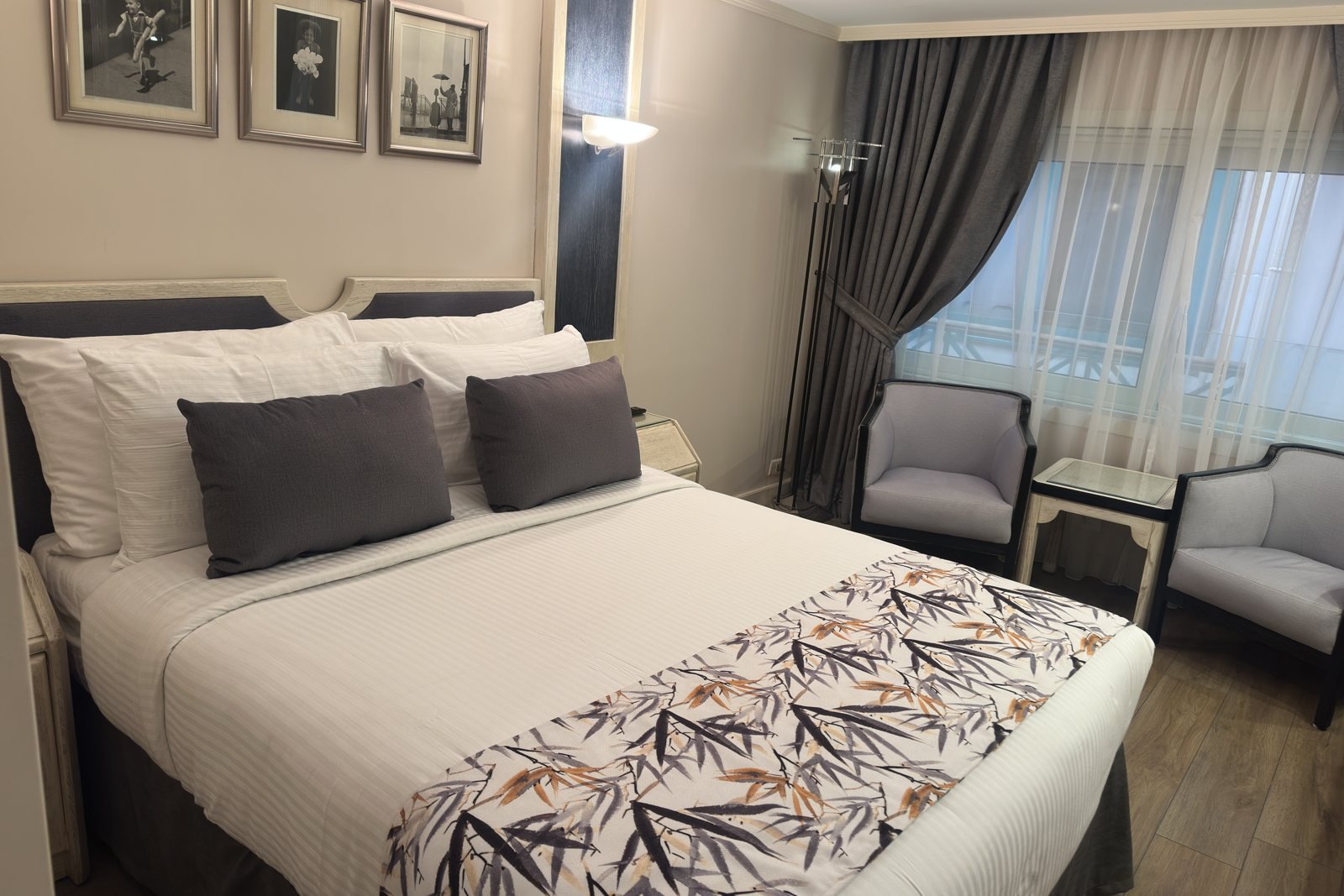
Guests ask me about cabins more than about any temple. Which deck, front or back, will it shake, will it smell, is the suite worth it. The brochures do not answer these questions, so here are the answers I give on the phone, from fifteen years of sleeping on these ships myself. The short answer is upper deck, middle of the ship. The long answer explains why, and what to do when that cabin is gone.
- Ask for the upper deck, in the middle of the ship. It is the furthest you can get from the engine room, and the view is best.
- The vibration comes from the engines and the propellers at the back, and from the generators that run all night. The lowest deck at the stern feels it most.
- Sailing from Luxor to Aswan the ship pushes against the current, so the engines work harder and you feel them more. Aswan to Luxor is quieter.
- Smells have three sources: the exhaust of the ships moored alongside, the galley, and old carpets and tanks on a tired boat. The cure is a well-kept ship and a closed window in port.
- In Luxor, Aswan and Edfu the ships moor side by side, so for a night your window may face another ship. Nobody can promise a river view at the moorings.
- A suite buys space and often a balcony. It does not buy a quieter ship or a different river.
How a Nile cruise ship is laid out
Almost every cruise ship on the Luxor to Aswan run is built the same way. Three decks of cabins, sometimes four, and a sun deck on top with the pool, the bar and the loungers. Reception and the restaurant are usually on the lowest passenger deck, the lounge bar one deck up. The engine room is at the stern, below the waterline, and the generators that power the air conditioning sit with it. The ships carry about 120 passengers; the biggest take up to 200.
Every cabin on the ships we work with is an outside cabin with a window on the river. The differences that matter are where the cabin sits on that layout: how high, how far forward, and what is above and below it.
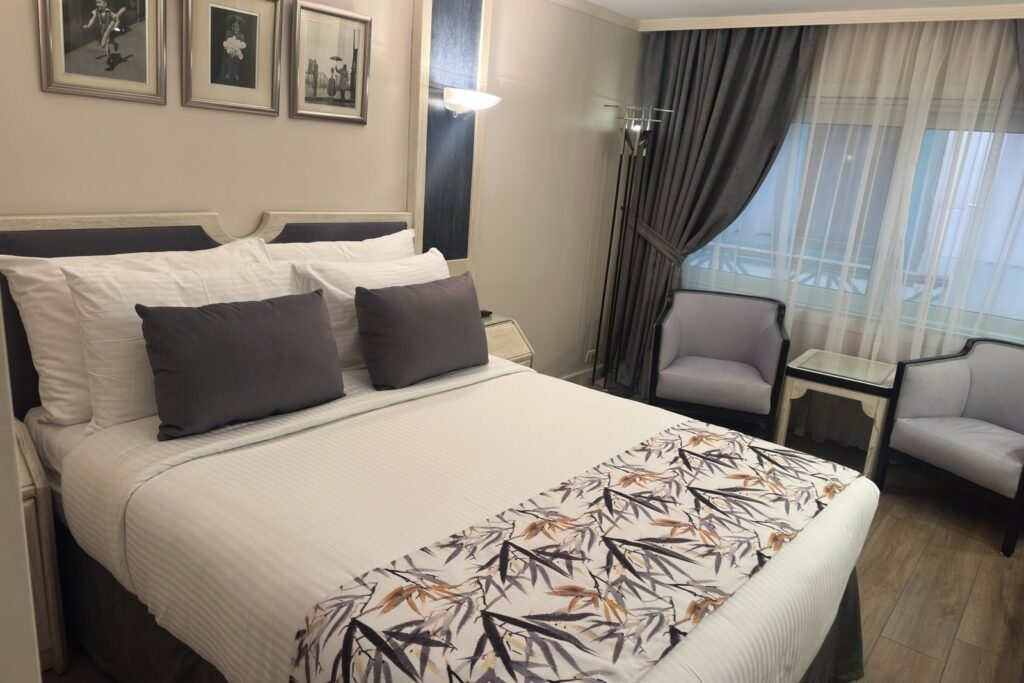
Why we ask for the upper deck, middle of the ship
The engine room is low and at the back. A cabin on the upper deck, halfway along the ship, is as far from it as you can get in both directions, up and forward, so it is the quietest cabin at night and the stillest when the ship is under way. It is also level with the treetops on the bank, which is the view people photograph.
The middle matters as much as the deck. The front of the ship is where the crew work the ropes and the anchor, and on most days that happens before six in the morning. The back is where the engines and the exhaust are. Halfway along, you hear neither.
The trade-off is one extra flight of stairs. Few of the ships have a lift, so if stairs are a problem for someone in your party, tell us and we will put you on the main deck instead and choose the cabin there with care.
Front or back
Forward cabins are quiet while the ship sails, and the first to hear the mooring crew at dawn. Aft cabins are near the engines and the propellers, and when the ship is moored with the generators running you feel a steady hum through the floor. Middle cabins get neither, which is why they go first.
There is one more thing worth knowing about the sides. Sailing south from Luxor to Aswan, the west bank is on your right, and that is the bank with the hills, the villages and the sunsets. Sailing north it is on your left. The ship turns at every mooring, so no cabin has the west bank all week, but if you are choosing between two cabins on the same deck, that is the one to pick.
Why the ship vibrates
A Nile cruise ship is a diesel boat with two propellers. When it moves you feel it, and you feel it most at the stern and on the lowest deck, where the cabin floor is a few metres from the engines. The vibration is strongest in three moments: when the ship leaves a mooring, when it manoeuvres at the Esna lock and the landing stages, and all the way from Luxor to Aswan, because that direction is upstream. The ship pushes against the current for four days, and the engines work harder. From Aswan to Luxor the river does part of the work and the ship runs quieter.
At night, moored, the engines are off but the generators are not. They power the air conditioning and run through the night, and in the cabins nearest the engine room you hear them as a hum. In a middle cabin on the upper deck you do not.
If vibration worries you, say so when you book and we will keep you away from the stern. If you are already on board and your bed trembles, tell your guide the first evening. Ships rarely sail full, and a cabin can often be changed on the spot.
Why some boats smell
This is the question people are shy to ask, so here is the honest answer. A clean ship does not smell. When one does, it is one of three things.
The first is other ships. In Luxor, Aswan and Edfu the ships moor side by side, three or four deep, and every one of them runs its generator. If your window is open and you are moored next to someone’s exhaust, your cabin smells of diesel. Close the window in port and keep the air conditioning on. It is why the cabins are air conditioned.
The second is the galley. The kitchen is on the lowest deck, usually towards the back, and the cabins nearest it get the smell of lunch at eleven in the morning. Another reason for the upper deck.
The third is the boat itself. Carpets that have been wet, tanks that are not emptied often enough, a ship that has not been refitted in years. This is the smell that does not go away, and the only cure is to choose the ship well. We work only with five-star ships, and when guests complain about a ship and the complaint is serious, we stop using it. If you tell us a ship had a smell we take it seriously, because we will be sleeping on it next week too.
Noise that is not vibration
Three things on a ship make noise that has nothing to do with the engines, and all three are about where your cabin is.
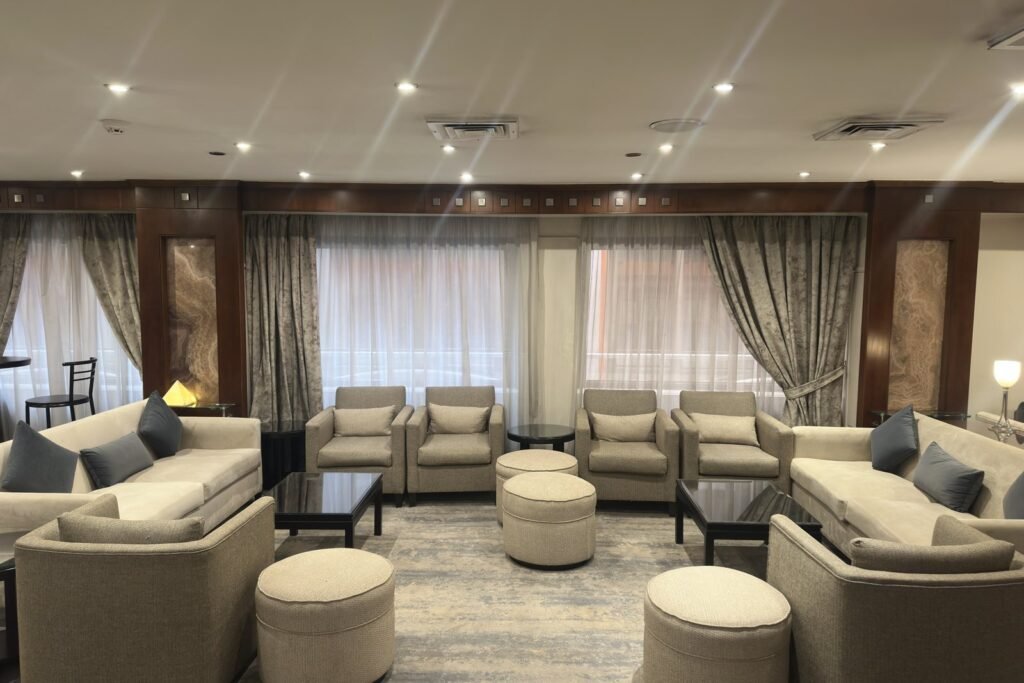
The lounge bar holds the Egyptian evening and sometimes a late disco. The cabins on the same deck, next to the lounge, hear it until it ends. The sun deck is hosed down early in the morning on some ships, and the top-deck cabins directly below hear the chairs being moved for a few minutes. And at Esna, ships wait in line for the lock, sometimes at night, and use their horns. None of this lasts long, but if you are a light sleeper, ask for a cabin that is not next to the lounge and bring earplugs for the lock night.
Cabin or suite
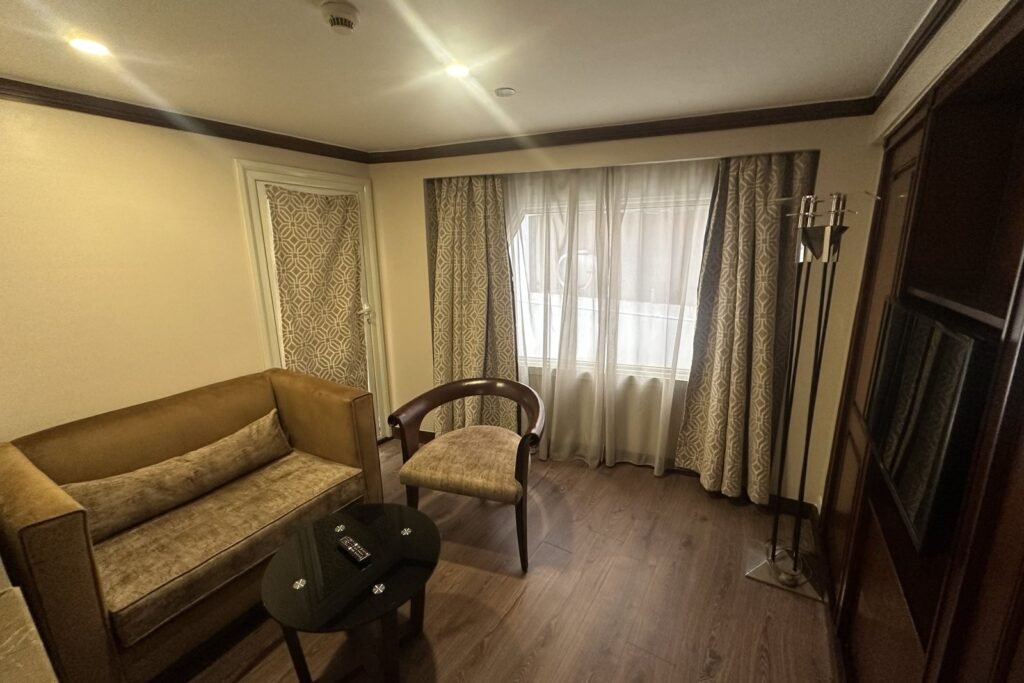
A standard cabin on the ships we use is a hotel room with a river window: a double or twin bed, a wardrobe, a bathroom with a shower. A suite adds space, a sitting area and, on some ships, a private balcony. The river outside is the same. The suite is worth it if you spend time in the cabin, want a sofa and a table, or want to sit outside in private rather than on the sun deck. It is not worth it for the view alone, because the window of a standard cabin shows the same bank.
We quote suites on request, because each ship prices them differently and the price depends on the sailing. Ask us when you enquire and we will tell you what the upgrade costs on the ship you are considering.
The moorings, and the view you cannot promise
Between the temples the ships sail, and the view from your window is the river. At the towns they tie up side by side at the landing stages, because there is not enough quay for everyone. In Luxor and Aswan, where the ships stay a night or two, you can be the third ship out with a wall of white steel a metre from your window, and to reach the shore you walk through the lobbies of the ships inside you.
This happens to every cabin on every ship, and no agent can promise you otherwise. It is one or two nights out of four, you spend them at the temples and in town anyway, and the curtain is there for a reason. I mention it because people who are not warned feel cheated, and people who are warned shrug.
Where each problem is worst, and what we do
| Problem | Worst | What we do |
|---|---|---|
| Vibration | Lowest deck, stern, sailing upstream | Book you upper deck, middle; change the cabin on board if a bed trembles |
| Generator hum at night | Cabins nearest the engine room | Same: keep you forward of the stern |
| Diesel smell in port | Any cabin with the window open | Tell you to keep the window shut at the moorings |
| Kitchen smell | Lowest deck near the galley | Upper deck |
| A tired ship | The whole ship | Five-star ships only, and we stop using a ship after a serious complaint |
| Lounge noise | Cabins beside the lounge bar | Ask for a cabin away from it if you sleep lightly |
| No view at the moorings | Every cabin, one or two nights | Warn you, so it is not a surprise |
What to ask before you book
Whoever you book with, ask these, and expect plain answers.
- Which deck is my cabin on, and is it forward, middle or aft?
- Is it above or next to the engine room, the galley or the lounge bar?
- When was the ship last refitted?
- Does the window open, or is it a fixed pane? Is there a French balcony?
- Is there a lift?
- Can two cabins be side by side for a family, or is there a cabin for three? See our family Nile cruises for how that works.
- If the cabin I am given is not the one I asked for, can it be changed on board?
We answer these for every booking, and we put the deck in writing. If you want to compare the ships first, start with the 4-night cruise and the ships that sail it, or read what a five-star Nile cruise ship really means. If you would rather have a boat with ten cabins and no engine room under you, read dahabiya or cruise ship.
If stairs or walking are a concern for anyone in your party, we have written honestly about a Nile cruise with limited mobility.
Questions
Is the upper deck worth paying more for?
On most ships the upper deck costs a little more than the main deck. For the quiet, the stillness and the view, yes. If the stairs are a problem, the main deck in the middle of the ship is the next best choice.
Do Nile cruise ships rock?
No. The Nile is a calm river with no swell, and the ships are wide and flat. Nobody gets seasick on a Nile cruise. What you feel is engine vibration, not motion.
Which side of the ship should I choose?
If you can choose, the side that faces the west bank sailing south, which is the right-hand side. The ship turns at the moorings, so you will see both banks over the week whatever you choose.
Can I change my cabin once I am on board?
Usually, if the ship has a free cabin, and it usually does. Tell your guide the first evening, not the last.
Do all cabins have windows?
On the ships we work with, yes, every cabin has a window on the river. On the lowest deck the window sits closer to the water.
Is a suite quieter than a cabin?
Not because it is a suite. Suites are usually on the upper decks, which is why they are quiet. A standard cabin on the same deck is just as quiet.
