

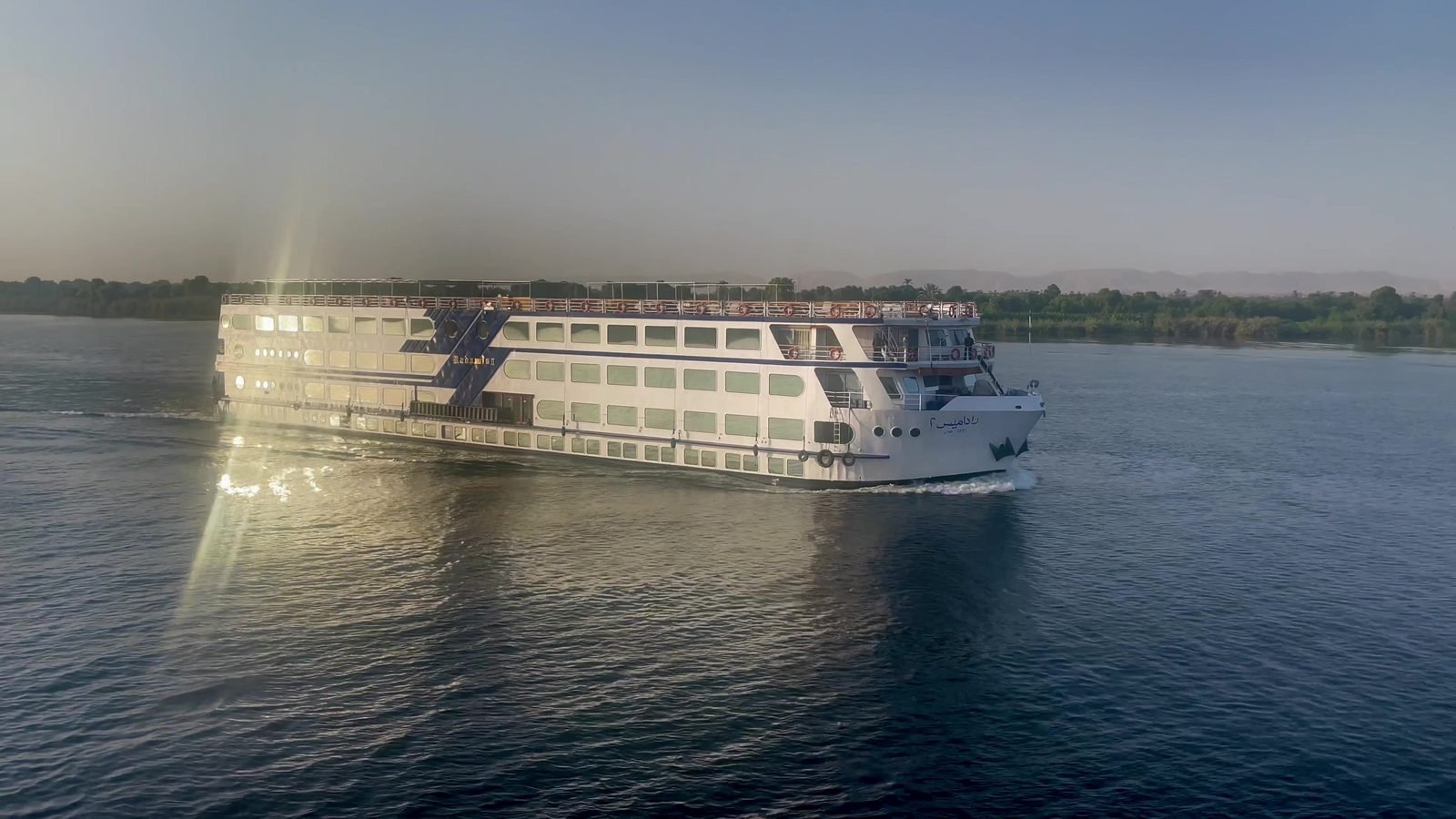
A Nile cruise star rating is not a review score and not a marketing claim. It comes from the Egyptian Ministry of Tourism and Antiquities, and it is written into the ship’s licence, the same licence that allows it to work the river at all. The words you see in brochures, standard and deluxe and luxury, are not on that licence. Those are ours, and every agency on the Nile uses them slightly differently.
- The stars come from the Ministry of Tourism and Antiquities and are part of the ship’s licence. A ship cannot award them to itself.
- Standard, deluxe and luxury are trade words. Two agencies can put the same ship in different bands and both are allowed.
- The price bands overlap. The cheapest deluxe ship costs less than the most expensive standard one.
- Every ship on this stretch visits the same temples. The higher band buys you the boat, not the history.
- For a first cruise we usually suggest deluxe: most of what people notice about a luxury ship, without the jump in price.
That gap is where most of the confusion comes from. A traveller reads five stars, then reads five stars again on a very different ship, and assumes one of the two is lying. Usually neither is. They are quoting the licence, and the licence is not describing the thing you care about.
Here is how it actually works, and what to look at instead.
Who decides a Nile cruise star rating
The Ministry of Tourism and Antiquities licenses every vessel that carries guests between Luxor and Aswan, and the category is set as part of that licence. It is a government grade, not something the ship awards itself. The grades run in stars, in the same way hotels are graded in Egypt.
The scale goes up to five stars, and there is a grade above five that a small number of vessels hold.
A ship cannot decide to move itself up. It also cannot sail without a licence at all, which is worth knowing when you are looking at a price that sits far below everything else.
Standard, deluxe and luxury are our words, not the licence’s
We sort our ships into standard, deluxe and luxury, and we will keep doing it, because those three words describe the experience better than a star count does. But we should be straight about what they are: a way of grouping ships by what a guest actually gets, invented by the travel trade, not a government category.
Which means two things for you. Another agency can call the same ship something different from what we call it, and both are allowed. And a ship can hold a high licence grade and still sit in a lower band on our site, or the other way round, because we are grading the week you will have on board, not the paperwork.
The licence tells you the ship is legal and what grade it holds. It does not tell you how the cabin smells, whether the buffet is any good, or when the carpets were last replaced.
What actually changes when you step on board
This is the part worth reading twice, because it is the part that changes your week. Across the ships we work with, the differences between the three bands show up in the same places every time.
| Standard | Deluxe | Luxury | |
|---|---|---|---|
| Cabin | Comfortable, twin or double, a window that opens, shower bathroom | Larger, often a sitting corner, a window the width of the room, bathtub on many ships | Largest cabins and suites, the most recent interiors, balconies on some ships |
| Public areas | Sun deck with a pool, a lounge, a restaurant | Sun deck with pool and pool bar, sometimes a jacuzzi, spa or sauna | More of everything, and the finishing is where the money shows: lifts, spas, several bars and restaurants |
| Food | Buffet, generous, straightforward | Buffet with more variety and better presentation, sometimes an à la carte option | Wider choice, more attention to how it is cooked and served |
| Guests on board | Usually fewer, a quieter boat | Mid-size to large | Ranges widely: some of the most exclusive ships are the smallest |
| Last refit | Varies the most, ask before booking | Usually the most recently refreshed group | Generally well maintained, though age still varies |
Notice what is not in that table: the temples. Every ship on this stretch follows the same route and stops at the same sites, and if you travel with us your Egyptologist is the same person whichever deck you sleep on. Read the day-by-day itinerary and you will see that the sightseeing does not change with the price. What you are buying with the higher band is the boat, not the history.
The price bands overlap, and that tells you something
Take the starting prices across the ships on our own site, per person for two sharing a cabin. Standard ships start between about $499 and $639. Deluxe ships start between about $549 and $859. Luxury ships start between about $699 and $1,490.
Look at where those ranges cross. The cheapest deluxe ship costs less than the most expensive standard ship. The cheapest luxury ship costs less than the most expensive deluxe one. If the label set the price, that could not happen.
What sets the price is the individual ship and the week you are sailing in, not the word attached to it. Which is why a shortlist beats a category. There is more on how the numbers move in how much a Nile cruise costs.
The old ships that sit above the labels
There is one group where the usual logic reverses. A handful of steamers still work the Nile, and they are not cheaper for being old. The best known is the Sudan, built in 1885 for the Egyptian royal family and later one of the largest boats in Thomas Cook’s Nile fleet. Agatha Christie sailed on her in 1933, and that voyage fed into Death on the Nile. The SS Misr is another steamer still working the river, part of the Mövenpick family.
These sit above the ordinary luxury ships and are priced accordingly. They are slower, they carry far fewer people, and they are a different kind of holiday. If someone tells you old means cheap on the Nile, the steamers are the exception that shows how little the age of a hull tells you on its own. The same goes the other way: a dahabiya is small and has no engine noise, and it is not a budget option either.
Why a ship you researched has a different name now
You will run into this. You read reviews of a ship, then cannot find it anywhere, or you find it under a name you have never seen. Ships on the Nile change names often, usually after a refit, because a new name lets the owner take the ship back to market as something fresh.
It matters for two reasons. Old reviews may describe a boat that has since been rebuilt, sometimes to a much higher standard. And glowing reviews may belong to a ship that has changed hands since. When a name looks new to us we check what it was before, and you can simply ask us.
Which class we put a first-timer on
Deluxe, almost every time.
The reason is straightforward. Deluxe carries most of what people actually notice about a luxury ship, the cabin size, the sun deck, the standard of the food, without the jump in price. Standard is genuinely fine, and plenty of our guests are happy on it, especially when the budget is going towards a longer trip or towards Abu Simbel. Luxury is worth it when the ship itself is part of the holiday for you, not just where you sleep between temples.
If you take one thing from this article: pick a ship, not a category.
How to check one specific ship before you book
Four questions will tell you more than any Nile cruise star rating.
When was it last refitted, and what was done. What is the actual cabin, deck and side, not just the grade. How many guests does it carry when it is full. And what name did it sail under before this one.
We have stood on most of the ships working this stretch of river, so ask us about a specific one and you will get a straight answer, including when the answer is that we would put you on something else. There is more on the order of decisions in how to book a Nile cruise without overpaying.
Tell us your dates and we will tell you honestly which boats are worth sailing that week, and which are not.
